Physio Bangkok/Treatments
Red Light Therapy in Bangkok
Aspire Physio Bangkok offers red light therapy on the Energy Lounger, a full-body red and near-infrared light bed, at our clinic in Jasmine Building, Sukhumvit Soi 23, a short walk from Asok BTS and Sukhumvit MRT. We use it alongside hands-on treatment and corrective exercise for pain, muscle tension and recovery. This page explains what red light therapy is, where it came from, what the published research shows (with every study linked), and how the Energy Lounger differs from the panels found in most clinics. Your first consultation is free: book through our contact page or call 082-281-8009.
- Free first consultation
- Licensed physiotherapists
- English and Thai
- Sukhumvit 23, near Asok BTS

What red light therapy is
Red light therapy is the everyday name for photobiomodulation (PBM): exposing the skin and the tissue underneath to specific wavelengths of red and near-infrared light at low power. It doesn’t cut, burn or tan the skin, and most people feel little more than gentle warmth. Researchers used to call it low-level laser therapy (LLLT); the field agreed on the term photobiomodulation therapy in 2015 because much of the work now uses LEDs rather than lasers [27].
The leading explanation for how it works sits inside your cells. Light in the red and near-infrared range is absorbed by cytochrome c oxidase in the mitochondria, the part of the cell that produces energy. That triggers a short chain of events: more ATP (cellular energy), a brief change in reactive oxygen species and nitric oxide, and changes in the signals that control inflammation and repair [25]. One of the most consistent effects in the research is a reduction in inflammation. Red wavelengths are mostly absorbed near the surface, while near-infrared light reaches deeper into muscle and joint tissue.
Dose matters. PBM follows a biphasic dose response: too little light does nothing, the right amount helps, and far more is not better and can blunt the effect [26]. That is one reason studies with poorly chosen doses tend to show no benefit, and why the reviews below often find stronger results when recommended doses are used.
A short history of red light therapy in medicine and sport
- 1903. Danish physician Niels Finsen receives the Nobel Prize in Physiology or Medicine “in recognition of his contribution to the treatment of diseases, especially lupus vulgaris, with concentrated light radiation” [28]. It is the first time medicine formally recognises light as a treatment. Finsen’s light was not red light therapy as we know it today, but it opened the door.
- 1960s to 1971. Soon after the first lasers were built, Hungarian surgeon Endre Mester in Budapest found that low-power laser light sped up wound healing in animals, published in the American Journal of Surgery in 1971 [29]. This is generally treated as the start of low-level laser therapy.
- 1990s to 2001. LEDs originally developed for NASA plant-growth experiments in space are tested on human tissue. A 2001 report supported by NASA’s Marshall Space Flight Center describes faster wound healing and an improvement of more than 40% in musculoskeletal training injuries in U.S. Navy SEAL team members treated with LED light [30]. This work helped move the field from lasers to LED arrays that can cover larger areas.
- 2002. The U.S. Food and Drug Administration clears its first low-level laser, the MicroLight 830, as a non-thermal instrument “for adjunctive use in pain therapy” [31].
- 2003 to 2010. Physiotherapy researchers, notably at the University of Bergen in Norway, show that results depend heavily on dose and on treating the right tissue. Their reviews on joint pain, tennis elbow and tendinopathy, and a 2009 meta-analysis on neck pain in The Lancet, move the evidence forward [1] [6] [10].
- 2010s. Sports science takes it up. Controlled trials test light on runners and on professional athletes, including a volleyball team treated before official matches [17] [18], and several meta-analyses pool the results on performance and recovery [12] [13].
- 2015. The term photobiomodulation therapy is adopted to describe the whole field, lasers and LEDs together [27].
- 2020s. Whole-body devices arrive in clinics and research labs. Randomised trials test full-body PBM for widespread chronic pain, and the first systematic review of whole-body PBM for exercise is published in 2025 [20] [24].
The Energy Lounger: our red light therapy bed
The Energy Lounger is a full-body red and near-infrared light therapy bed made by EnergyLounger (offices in the USA and the Netherlands). Instead of standing in front of a panel, you lie back on a contoured lounger with the light built into the surface underneath you. Published specifications for the device list [32] [33]:
- Three wavelengths: red light at about 630 to 640 nm and two near-infrared wavelengths at 850 nm and 950 nm.
- 21 replaceable LED panels with 1,260 LEDs for head-to-toe coverage.
- About 5 mm (0.2 inch) between your skin and the lights, through a protective surface layer.
- Five preset programmes, including a muscle recovery setting (630 nm plus 850 nm), a pain management setting (630 nm plus 950 nm) and a full-spectrum setting using all three.
- Sessions of about 20 minutes, with built-in cooling fans and an ergonomic, reclined design.
Your first consultation is free. A physiotherapist will assess you properly and explain what’s going on, with no pressure to book more.
How the Energy Lounger differs from typical red light panels
Most clinics and gyms in Bangkok that offer red light use flat LED panels, mounted on a wall, a stand or a door, which you stand or sit in front of. Panels can work well for one area. The Energy Lounger is built differently, and for physiotherapy the differences matter.
| Typical red light panel | Energy Lounger | |
|---|---|---|
| Position | You stand or sit in front of it and hold still. | You recline on it, fully supported, so muscles can switch off. |
| Distance from the light | Usually several centimetres to tens of centimetres, and it changes if you move or lean. | A fixed gap of about 5 mm through the surface layer, the same every session. |
| Coverage | One side of the body, or one area, at a time. | Head to toe along the back of the body at once: neck, upper and lower back, glutes, hamstrings and calves. |
| Wavelengths | Commonly one red and one near-infrared wavelength. | One red and two near-infrared wavelengths (630 to 640, 850 and 950 nm) with preset programmes. |
| Consistency of dose | Light spreads out and weakens with distance, so the dose depends on where you stand. | Because the distance is fixed, each area receives a more repeatable dose from one session to the next. |
| Experience | Short, standing sessions. | A 20-minute supported rest, which many clients use to wind down after treatment or training. |
Why this matters for us: the areas the lounger covers best, the neck and shoulders, the back, the glutes and the legs, are exactly where desk tension, back pain and training load build up. And because dose drives results in PBM [26], a set distance is a practical advantage over standing in front of a panel.
To be clear about the limits: most of the clinical trials below used lasers or LED clusters applied to specific points, not whole-body beds. Research on whole-body devices is newer and smaller, and we summarise it, limits included, in its own section.
What the research shows
Below is a summary of systematic reviews, meta-analyses and randomised controlled trials on red and near-infrared light for pain, muscle tension, rehabilitation and recovery. Every study is published in a peer-reviewed journal, indexed in PubMed and linked to its original paper. We have included results that did not favour light therapy as well as those that did.
Neck pain and neck and shoulder tension
- Chow and colleagues, The Lancet, 2009. A meta-analysis of 16 randomised trials with 820 patients. In chronic neck pain, light therapy reduced pain by about 20 mm on a 100 mm scale compared with placebo, and relief persisted for up to 22 weeks after treatment ended. Side effects were mild and no different from placebo [1].
- Tehrani and colleagues, Lasers in Medical Science, 2022. 13 randomised trials, 556 patients with myofascial neck pain. Light therapy reduced pain and raised the pressure the muscles could tolerate before hurting. The authors recommend using it alongside manual therapy and exercise [2].
- Alayat and colleagues, Photobiomodulation, Photomedicine, and Laser Surgery, 2022. 17 studies, 944 patients with trigger point pain in the upper trapezius, the classic desk-worker “tension” muscle. Light alone had a medium effect on pain; light combined with exercise had a large effect [3].
- A more cautious view: Kadhim-Saleh and colleagues, Rheumatology International, 2013. Eight trials, 443 patients. The improvement was statistically significant but below the threshold the authors considered clinically important, and they called the evidence inconclusive [4].
Back pain, joint pain and musculoskeletal pain
- Clijsen and colleagues, European Journal of Physical and Rehabilitation Medicine, 2017. 18 studies, 1,462 participants with musculoskeletal disorders. Light therapy reduced pain, and trials that followed the World Association for Laser Therapy dose guidelines showed roughly double the effect [5].
- Bjordal and colleagues, Australian Journal of Physiotherapy, 2003. 11 trials, 565 patients with chronic joint pain in the knee, jaw and spinal facet joints. With adequate doses, pain fell by about 30 mm on a 100 mm scale more than placebo [6].
- Glazov and colleagues, Acupuncture in Medicine, 2016. 15 trials, 1,039 people with chronic non-specific low back pain. Moderate-quality evidence of a clinically important short-term reduction in pain, seen with higher doses and in people whose pain had lasted less than 30 months [7].
- Stausholm and colleagues, BMJ Open, 2019. 22 placebo-controlled trials, 1,063 people with knee osteoarthritis. Light therapy reduced pain and disability, with the largest benefit at recommended doses, peaking two to four weeks after treatment ended. No adverse events were reported [8].
Tendon pain and rehabilitation
- Haslerud and colleagues, Physiotherapy Research International, 2015. 17 randomised trials in shoulder tendinopathy. Clinically relevant pain relief on its own and as an add-on to exercise therapy. Trials using inadequate doses showed no effect [9].
- Bjordal and colleagues, BMC Musculoskeletal Disorders, 2008. 13 trials, 730 patients with tennis elbow. Correctly dosed light applied directly to the tendon gave short-term pain relief and less disability, alone and combined with exercise [10].
- Tumilty and colleagues, Photomedicine and Laser Surgery, 2010. 25 trials in tendinopathy with mixed results: 12 positive and 13 inconclusive or negative. The positive trials were the ones that used recommended doses [11].
Muscle recovery, soreness and performance
- Leal-Junior and colleagues, Lasers in Medical Science, 2015. 13 randomised trials. Light therapy increased repetitions and time to exhaustion and improved markers of recovery, with the most consistent results when applied before exercise [12].
- Vanin and colleagues, Lasers in Medical Science, 2018. 39 trials, 861 participants. Some effect in favour of light for performance and fatigue, using wavelengths between 655 and 950 nm, but with very low to moderate quality of evidence [13].
- Ferlito and colleagues, Lasers in Medical Science, 2022. Compared light therapy with cold therapy after hard exercise. Light therapy came out ahead for strength, delayed-onset muscle soreness and markers of muscle damage, although the evidence base was small (four trials, 66 people) [14].
- Chen and colleagues, Journal of Pain Research, 2025. A network meta-analysis of physical therapy options for delayed-onset muscle soreness. Light therapy was the only option to beat placebo at 24 hours and remained effective at 48 hours; no option helped beyond 48 hours [15].
- A negative review: Nampo and colleagues, Lasers in Medical Science, 2016. 15 studies, 317 participants given a single session of light. It found little effect on muscle soreness or damage overall, while noting small, varied studies [16].
- Ferraresi and colleagues, Lasers in Medical Science, 2015. A double-blind trial in a professional volleyball team. Red (630 nm) and near-infrared (850 nm) LEDs applied before official matches prevented the rise in the muscle damage marker creatine kinase seen with placebo [17].
- De Marchi and colleagues, Lasers in Medical Science, 2012. A double-blind crossover trial in 22 men. Light applied before a treadmill test improved VO2 max and time to exhaustion and reduced markers of muscle damage and oxidative stress [18].
- Ferraresi, Huang and Hamblin, Journal of Biophotonics, 2016. A review of 46 studies with 1,045 participants, including elite athletes, covering both pre-conditioning before exercise and treatment after it [19].
Whole-body red light therapy
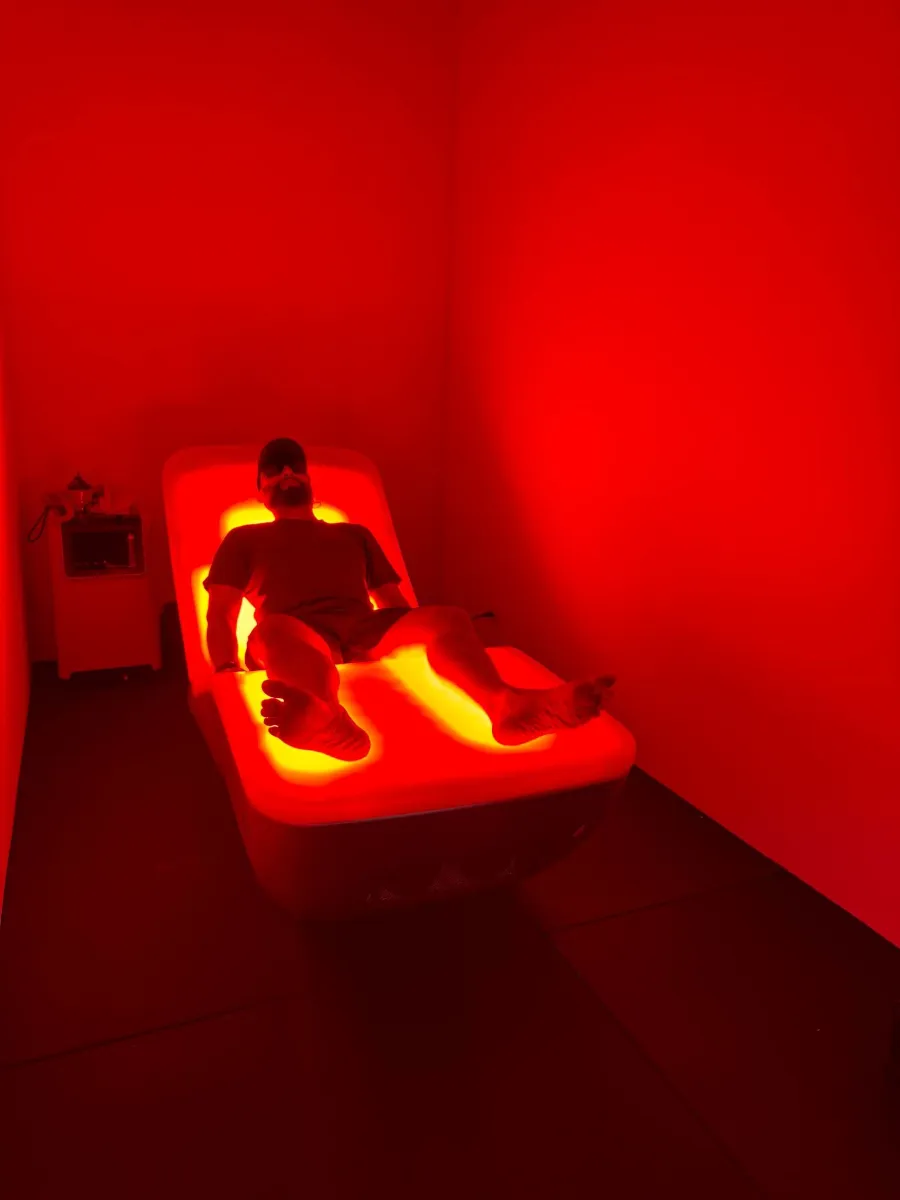
- Navarro-Ledesma and colleagues, Pain and Therapy, 2022, with 6-month follow-up in Frontiers in Neuroscience, 2024. A triple-blind, placebo-controlled randomised trial in 42 people with fibromyalgia, a condition of widespread muscle pain. Twelve whole-body sessions reduced pain and improved quality of life, with benefits still present at six months. Two authors worked for a light therapy manufacturer [20] [21].
- Fitzmaurice and colleagues, Behavioural Sciences, 2023. An NHS feasibility trial of 18 whole-body sessions in people with fibromyalgia. Participants reported improvements in pain, stiffness, fatigue and sleep. As a single-arm study with no placebo group it cannot prove cause, but it supported a full trial [22].
- Forsey and colleagues, Lasers in Medical Science, 2023. 48 active adults, 20 minutes of whole-body light before all-out cycling sprints. It did not improve power output, but heart rate variability, a marker of recovery, was higher the next morning [23].
- Álvarez-Martínez and Borden, Lasers in Medical Science, 2025. The first systematic review of whole-body PBM for exercise, covering five studies and 105 participants. Whole-body light may improve sleep quality but showed no clear benefit for exercise performance or recovery markers [24].
What we take from the evidence
- The strongest evidence is for pain: neck pain, trigger point and myofascial pain, tendon pain, back pain and joint pain, usually over the short to medium term.
- Results are better when light is combined with exercise than on its own, which is exactly how we use it [3] [9].
- Dose matters. Reviews repeatedly find that trials using recommended doses do better [5] [8] [11].
- For recovery and soreness, the evidence is positive but mixed, and benefits are mainly in the first 48 hours.
- Whole-body light is promising for widespread pain and sleep, but the research is still young, and it has not been shown to boost athletic performance.
How we use red light therapy at Aspire Physio
We go beyond conventional physiotherapy and beyond the symptoms. Every client starts with an assessment of how you move, where the pain is coming from and what’s driving it. Red light therapy is one of the tools we may add, alongside manual therapy and dry needling, to calm pain and tension so you can move and train. It doesn’t build strength, fix a muscle imbalance or rebuild a tendon’s capacity. That work happens through corrective exercise, coached by your physiotherapist on the gym floor, often in the same session.
Clients who tend to get the most from adding it include desk workers with neck, shoulder and back tension (see office syndrome), people with tendon or joint pain who are already doing their strengthening, and active people and lifters managing heavy training soreness or in the early phase of a sports injury. We only suggest it where the research and your assessment say it’s likely to help. Once you’re out of rehab, the Aspire Coaching gym in the same building, theaspireclub.com can carry on with longer-term strength work.
Safety
Across the reviews above, side effects were uncommon and mild, and several reported none [1] [8]. A few sensible precautions still apply:
- Protect your eyes. We provide eye protection; don’t look directly into the light.
- Tell us if you have, or are being investigated for, cancer. Light is not applied over a known or suspected tumour.
- Tell us if you’re pregnant. We take a cautious approach.
- Tell us about any medicines or skin conditions that make you sensitive to light.
- Let us know straight away if anything feels too warm or uncomfortable, and we’ll stop.
Some pain needs a doctor before any clinic treatment. See a doctor first if your pain follows a serious fall or accident, comes with fever or unexplained weight loss, or you have new numbness or weakness in the legs, or any change in bladder or bowel control.
Cost and insurance
Your first consultation is free. Ask us about Energy Lounger sessions for current pricing. You can claim treatment with your insurer and we supply the documents your provider asks for; cover for add-on treatments varies, so check with your insurer. See our insurance claims page for how claiming works.
Your physiotherapists
You’ll be seen by one of our licensed physiotherapists: Boom Namsak, who is also a strength coach, Gino Udomthanakij or Som Benjaprasertsri. All three work in English and Thai.


Common questions
What is photobiomodulation?
Photobiomodulation is the scientific name for red light therapy: using low-power red and near-infrared light to influence how cells produce energy and manage inflammation and repair.
Is red light therapy backed by research?
Yes, for several uses. Meta-analyses in journals including The Lancet and BMJ Open show pain reduction in neck pain, knee osteoarthritis, tendon pain and other musculoskeletal conditions. Evidence for muscle recovery is positive but mixed, and research on whole-body beds is newer.
What is the Energy Lounger?
A full-body red light therapy bed. You recline on it for about 20 minutes while red (630 to 640 nm) and near-infrared (850 and 950 nm) LEDs built into the surface treat the back of the body from head to toe.
How is the Energy Lounger different from a red light panel?
With a panel you stand in front of the light and the dose changes with distance. On the Energy Lounger you recline on the light at a fixed distance of about 5 mm, it covers the back of the body in one session, and it uses three wavelengths with preset programmes.
Can red light therapy replace physiotherapy exercises?
No. It doesn’t build strength or change how you move. Research shows better results when light is combined with exercise, and that’s how we use it.
Is red light therapy safe?
It’s generally well tolerated, and side effects in the research were uncommon and mild. Wear the eye protection provided, and tell us about pregnancy, cancer, light-sensitising medicines or skin conditions before treatment.
How much does physiotherapy cost at Aspire?
Your first consultation is free. The exact cost depends on what your session involves, and we’ll confirm it with you before you commit to anything. You can claim with your insurer, and we supply the documents your provider asks for.
Book your first consultation
Aspire Physio Bangkok is at Jasmine Building, 2nd Floor, Sukhumvit Road, Soi 23, Klongtoey, Bangkok 10110. We’re open Monday to Friday 7am to 8pm, and Saturday and Sunday 8am to 4pm. Bookings are required in advance. Message us through our contact page or call 082-281-8009.
References
Show 33 references
All journal studies are indexed in PubMed. Links go to the original published paper.
- Chow RT, Johnson MI, Lopes-Martins RAB, Bjordal JM. Efficacy of low-level laser therapy in the management of neck pain: a systematic review and meta-analysis of randomised placebo or active-treatment controlled trials. Lancet. 2009;374(9705):1897-1908. doi:10.1016/S0140-6736(09)61522-1
- Tehrani MR, Nazary-Moghadam S, Zeinalzadeh A, et al. Efficacy of low-level laser therapy on pain, disability, pressure pain threshold, and range of motion in patients with myofascial neck pain syndrome: a systematic review and meta-analysis of randomized controlled trials. Lasers Med Sci. 2022;37(9):3333-3341. doi:10.1007/s10103-022-03626-9
- Alayat MSM, Battecha KH, Elsodany AM, et al. Effectiveness of photobiomodulation therapy in the treatment of myofascial pain syndrome of the upper trapezius muscle: a systematic review and meta-analysis. Photobiomodul Photomed Laser Surg. 2022;40(10):661-674. doi:10.1089/photob.2022.0056
- Kadhim-Saleh A, Maganti H, Ghert M, Singh S, Farrokhyar F. Is low-level laser therapy in relieving neck pain effective? Systematic review and meta-analysis. Rheumatol Int. 2013;33(10):2493-2501. doi:10.1007/s00296-013-2742-z
- Clijsen R, Brunner A, Barbero M, Clarys P, Taeymans J. Effects of low-level laser therapy on pain in patients with musculoskeletal disorders: a systematic review and meta-analysis. Eur J Phys Rehabil Med. 2017;53(4):603-610. doi:10.23736/S1973-9087.17.04432-X
- Bjordal JM, Couppé C, Chow RT, Tunér J, Ljunggren EA. A systematic review of low level laser therapy with location-specific doses for pain from chronic joint disorders. Aust J Physiother. 2003;49(2):107-116. doi:10.1016/s0004-9514(14)60127-6
- Glazov G, Yelland M, Emery J. Low-level laser therapy for chronic non-specific low back pain: a meta-analysis of randomised controlled trials. Acupunct Med. 2016;34(5):328-341. doi:10.1136/acupmed-2015-011036
- Stausholm MB, Naterstad IF, Joensen J, et al. Efficacy of low-level laser therapy on pain and disability in knee osteoarthritis: systematic review and meta-analysis of randomised placebo-controlled trials. BMJ Open. 2019;9(10):e031142. doi:10.1136/bmjopen-2019-031142
- Haslerud S, Magnussen LH, Joensen J, Lopes-Martins RAB, Bjordal JM. The efficacy of low-level laser therapy for shoulder tendinopathy: a systematic review and meta-analysis of randomized controlled trials. Physiother Res Int. 2015;20(2):108-125. doi:10.1002/pri.1606
- Bjordal JM, Lopes-Martins RAB, Joensen J, et al. A systematic review with procedural assessments and meta-analysis of low level laser therapy in lateral elbow tendinopathy (tennis elbow). BMC Musculoskelet Disord. 2008;9:75. doi:10.1186/1471-2474-9-75
- Tumilty S, Munn J, McDonough S, Hurley DA, Basford JR, Baxter GD. Low level laser treatment of tendinopathy: a systematic review with meta-analysis. Photomed Laser Surg. 2010;28(1):3-16. doi:10.1089/pho.2008.2470
- Leal-Junior ECP, Vanin AA, Miranda EF, de Carvalho PTC, Dal Corso S, Bjordal JM. Effect of phototherapy (low-level laser therapy and light-emitting diode therapy) on exercise performance and markers of exercise recovery: a systematic review with meta-analysis. Lasers Med Sci. 2015;30(2):925-939. doi:10.1007/s10103-013-1465-4
- Vanin AA, Verhagen E, Barboza SD, Costa LOP, Leal-Junior ECP. Photobiomodulation therapy for the improvement of muscular performance and reduction of muscular fatigue associated with exercise in healthy people: a systematic review and meta-analysis. Lasers Med Sci. 2018;33(1):181-214. doi:10.1007/s10103-017-2368-6
- Ferlito JV, Ferlito MV, Leal-Junior ECP, Tomazoni SS, De Marchi T. Comparison between cryotherapy and photobiomodulation in muscle recovery: a systematic review and meta-analysis. Lasers Med Sci. 2022;37(3):1375-1388. doi:10.1007/s10103-021-03442-7
- Chen J, Hu Q, Hu J, Liu S, Yin L. Differences in the effectiveness of different physical therapy modalities in the treatment of delayed-onset muscle soreness: a systematic review and Bayesian network meta-analysis. J Pain Res. 2025;18:2993-3008. doi:10.2147/JPR.S519242
- Nampo FK, Cavalheri V, Ramos SdP, Camargo EA. Effect of low-level phototherapy on delayed onset muscle soreness: a systematic review and meta-analysis. Lasers Med Sci. 2016;31(1):165-177. doi:10.1007/s10103-015-1832-4
- Ferraresi C, dos Santos RV, Marques G, et al. Light-emitting diode therapy (LEDT) before matches prevents increase in creatine kinase with a light dose response in volleyball players. Lasers Med Sci. 2015;30(4):1281-1287. doi:10.1007/s10103-015-1728-3
- De Marchi T, Leal Junior ECP, Bortoli C, Tomazoni SS, Lopes-Martins RAB, Salvador M. Low-level laser therapy (LLLT) in human progressive-intensity running: effects on exercise performance, skeletal muscle status, and oxidative stress. Lasers Med Sci. 2012;27(1):231-236. doi:10.1007/s10103-011-0955-5
- Ferraresi C, Huang YY, Hamblin MR. Photobiomodulation in human muscle tissue: an advantage in sports performance? J Biophotonics. 2016;9(11-12):1273-1299. doi:10.1002/jbio.201600176
- Navarro-Ledesma S, Carroll J, Burton P, González-Muñoz A. Short-term effects of whole-body photobiomodulation on pain, quality of life and psychological factors in a population suffering from fibromyalgia: a triple-blinded randomised clinical trial. Pain Ther. 2023;12(1):225-239. doi:10.1007/s40122-022-00450-5
- Navarro-Ledesma S, Carroll JD, González-Muñoz A, Burton P. Outcomes of whole-body photobiomodulation on pain, quality of life, leisure physical activity, pain catastrophizing, kinesiophobia, and self-efficacy: a prospective randomized triple-blinded clinical trial with 6 months of follow-up. Front Neurosci. 2024;18:1264821. doi:10.3389/fnins.2024.1264821
- Fitzmaurice BC, Heneghan NR, Rayen ATA, Grenfell RL, Soundy AA. Whole-body photobiomodulation therapy for fibromyalgia: a feasibility trial. Behav Sci (Basel). 2023;13(9):717. doi:10.3390/bs13090717
- Forsey JD, Merrigan JJ, Stone JD, et al. Whole-body photobiomodulation improves post-exercise recovery but does not affect performance or physiological response during maximal anaerobic cycling. Lasers Med Sci. 2023;38(1):111. doi:10.1007/s10103-023-03759-5
- Álvarez-Martínez M, Borden G. A systematic review on whole-body photobiomodulation for exercise performance and recovery. Lasers Med Sci. 2025;40(1):55. doi:10.1007/s10103-025-04318-w
- Hamblin MR. Mechanisms and applications of the anti-inflammatory effects of photobiomodulation. AIMS Biophys. 2017;4(3):337-361. doi:10.3934/biophy.2017.3.337
- Huang YY, Chen ACH, Carroll JD, Hamblin MR. Biphasic dose response in low level light therapy. Dose Response. 2009;7(4):358-383. doi:10.2203/dose-response.09-027.Hamblin
- Anders JJ, Lanzafame RJ, Arany PR. Low-level light/laser therapy versus photobiomodulation therapy. Photomed Laser Surg. 2015;33(4):183-184. doi:10.1089/pho.2015.9848
- The Nobel Prize in Physiology or Medicine 1903: Niels Ryberg Finsen. NobelPrize.org. nobelprize.org
- Mester E, Spiry T, Szende B, Tota JG. Effect of laser rays on wound healing. Am J Surg. 1971;122(4):532-535. doi:10.1016/0002-9610(71)90482-x
- Whelan HT, Smits RL, Buchman EV, et al. Effect of NASA light-emitting diode irradiation on wound healing. J Clin Laser Med Surg. 2001;19(6):305-314. doi:10.1089/104454701753342758
- U.S. Food and Drug Administration. 510(k) premarket notification K010175, MicroLight 830 Laser System, decision date 6 February 2002. accessdata.fda.gov
- EnergyLounger. Full-body red and near-infrared light therapy. Manufacturer website. energylounger.com
- Energy Lounger product specifications (wavelengths, LED count, programmes, dimensions). Distributor listing, Blue Sky Fitness Supply. blueskyfitsupply.com
Free first consultation