
Physio Bangkok/Conditions
Office Syndrome Treatment in Bangkok
Aspire Physio Bangkok treats office syndrome at our clinic on Sukhumvit Soi 23, a short walk from Asok BTS and Sukhumvit MRT. Our licensed physiotherapists settle the neck, shoulder, upper back and wrist pain that comes from long hours at a desk, then coach you through the corrective exercise that stops it coming back. Your first consultation is free, and you can book through our contact page or by calling 082-281-8009.
- Free first consultation
- Licensed physiotherapists
- English and Thai
- Sukhumvit 23, near Asok BTS


Your physio team
Licensed physiotherapists who assess and treat you themselves, in English or Thai, from treatment through to the gym floor.
- A review of your history and pain patterns
- A screen to find the root cause
- A treatment plan for you to consider
What office syndrome is
Office syndrome is the everyday name for the aches that build up when you spend most of your day sitting still in front of a screen. It isn’t a single diagnosis. It’s a cluster of muscle and joint problems that share one cause: the same position, held for hours, day after day.
When you sit for long periods, your head drifts forward, your shoulders round and your upper back stiffens. Some muscles end up working all day to hold you up, like the ones across the top of your shoulders and the back of your neck. Others switch off, like the muscles between your shoulder blades and the deep muscles at the front of your neck. Over months, that imbalance becomes the way your body sits by default. The overworked muscles get tight and sore, and the underused ones get weak.
That’s why a massage feels great on Friday and the pain is back by Wednesday. The weak muscles are a big part of the cause.
Why it’s so common in Bangkok offices
Most of the people we see with office syndrome work in the towers around Asok, Sukhumvit and Silom. The pattern is familiar:
- Long hours. Ten hour days at a desk are normal for a lot of our clients, and lunch is often eaten at the keyboard.
- The commute. A long ride on the BTS or MRT, or an hour in a taxi, usually means more sitting and more time looking down at a phone.
- Air conditioning. Cold offices make people hunch their shoulders and tense up without noticing. Many clients tell us their neck feels worse on days they sit under a vent.
- Laptops and hot desks. A laptop on a desk puts the screen too low and the keyboard too high. Hot desking means your setup changes every day.
- Little time to train. When work runs late, exercise is the first thing to go, so the muscles that should be supporting you get weaker.
Symptoms people come in with
Clients rarely say “I have office syndrome”. They describe it like this:
- A stiff, aching neck that gets worse through the afternoon
- Tight, knotted shoulders, often worse on the side of your mouse hand
- A burning or nagging spot between the shoulder blades
- Tension headaches that start at the base of the skull and wrap around to the forehead or behind the eyes
- Wrist or forearm pain from typing and using a mouse
- Tingling or pins and needles in the hands or fingers
- Lower back stiffness and tight hips when you stand up after a long meeting
If your hips are part of the picture, our post on whether your desk job is quietly destroying your hips explains what’s happening there.
Your first consultation is free. A physiotherapist will assess you properly and explain what’s going on, with no pressure to book more.
When to see a doctor first
Most office syndrome is muscular and responds well to physiotherapy. Some symptoms need a medical check before treatment. See a doctor promptly if you have:
- Numbness, tingling or weakness in your arms or hands that is spreading or getting worse
- Clumsiness in your hands or trouble with balance or walking
- A sudden, severe headache unlike anything you’ve had before
- Dizziness, blurred or double vision, or difficulty speaking or swallowing
- Neck or arm pain that comes with chest pain or shortness of breath
- Fever, unexplained weight loss, or pain that is severe at night and doesn’t ease with rest
- Pain that started after a fall, accident or other injury
If you’re not sure, come in for the free consultation. If your physiotherapist thinks you need medical assessment first, they’ll tell you and explain why.
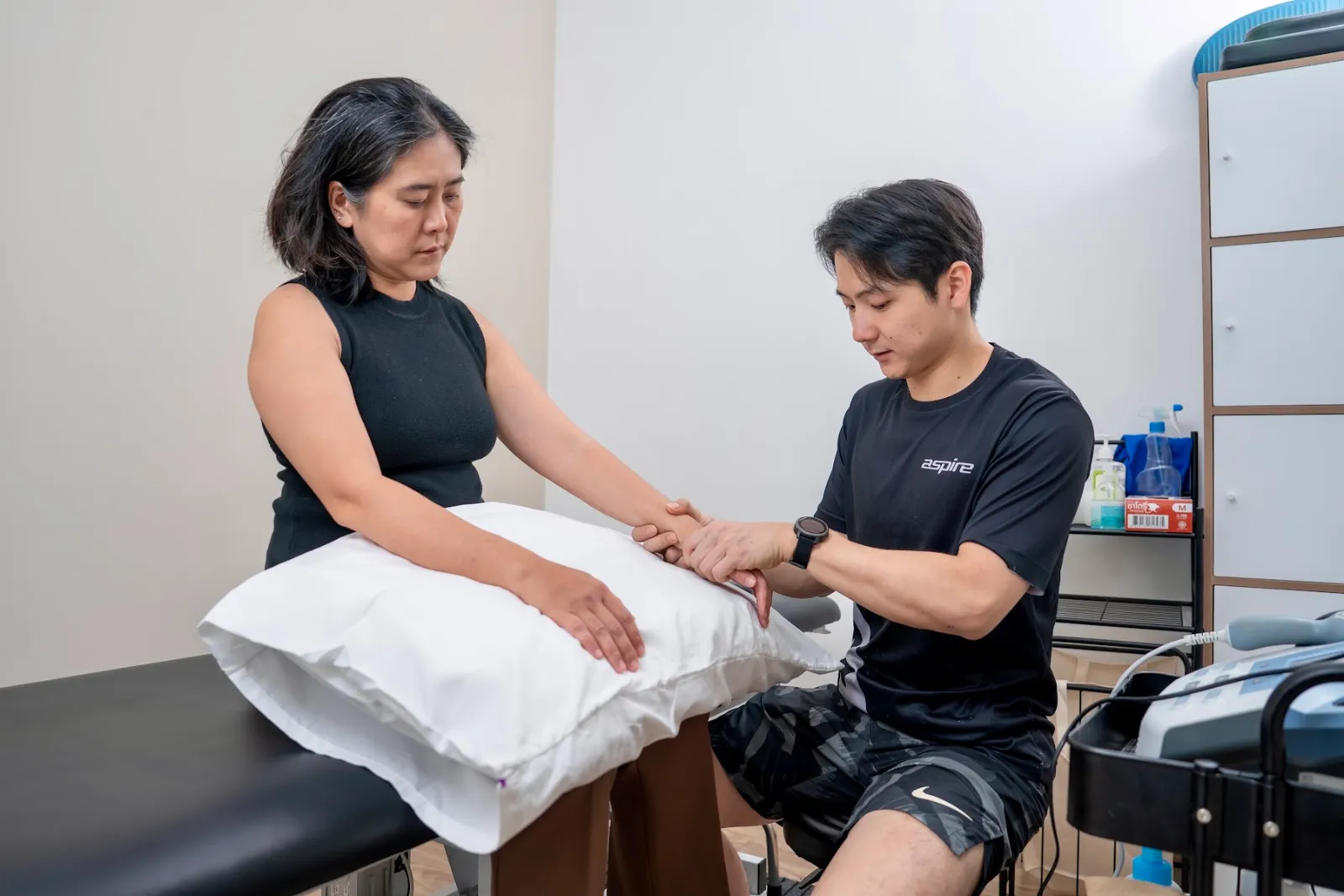
How we treat office syndrome
Our approach is corrective rehab through exercise. Hands-on treatment settles the pain. Strength and corrective exercise fix the imbalance behind it. Here’s how that usually runs.
First session: assessment
Your physiotherapist asks about your work, your hours, your training and where the pain shows up. Then they test the range of your neck, shoulders and upper back, check which muscles are tight and which are weak, and look for signs of a nerve being involved. You’ll leave knowing what’s driving your pain and what the plan is.
Settling the pain
When your neck and shoulders are sore, the first job is calming them down. Depending on what we find, that can include manual therapy such as joint mobilisation, trigger point therapy, myofascial release and deep tissue or sports massage. Dry needling is often useful for the tight bands across the upper shoulders and neck. We use these as needed. They make you more comfortable and help you move better, which makes the next step possible.
The gym floor: strength and corrective exercise
This is the part that changes the outcome. Your physiotherapist takes you upstairs to the gym floor, often in the same session once the pain has eased enough, and coaches you through the exercises that rebuild the muscles your desk has switched off. That usually means the muscles between your shoulder blades, the deep neck flexors and the muscles that hold your upper back upright. Each week the exercises progress so you keep getting stronger.
The gym is part of the Aspire Coaching studio, in the same building. If you want to keep training once your rehab is done, you can carry on there with a strength coach who already knows your history.
Changes to make at your workstation
Your setup won’t fix office syndrome on its own, but a bad one keeps undoing your progress. Start with these:
- Screen height. The top of your screen should sit around eye level so you look straight ahead. If you use a laptop all day, raise it on a stand and use a separate keyboard and mouse.
- Chair. Sit back in the chair so it supports your lower back. Adjust the height so your feet rest flat on the floor and your knees sit about level with your hips.
- Keyboard and mouse. Keep them close so your elbows stay near your sides and bent to about a right angle. Your wrists should be roughly straight, not bent up or to the side.
- Phone. Use a headset or speaker for calls. Wedging a phone between ear and shoulder is a reliable way to set off neck pain.
- Air con. If you sit under a cold vent, ask to move or keep a light layer over your shoulders.
Above all, move more often. No position is perfect for eight hours.
Want your set-up checked? We also run workplace ergonomic assessments. A physiotherapist looks at how your desk, chair, screen and working habits fit you, tells you what to change, and pairs it with exercises for any areas that are already sore. Companies can book assessments for their teams. Call 082-281-8009 to ask, or read our guide to ergonomic assessments in the workplace.
For your own posture, a quick posture check is part of your free first consultation. If you want more detail, book a full posture assessment, which looks at how you stand, sit and move and ends with a corrective exercise plan.
Desk-break exercises
These are a starting point for a short break every hour or so. Move slowly, stay in a comfortable range and stop if anything causes sharp pain, pins and needles or dizziness. Your physiotherapist will adjust them to suit you.
- Chin tucks. Sit tall. Gently draw your chin straight back, as if making a double chin, keeping your eyes level. Hold for a few seconds, then relax. Repeat 8 to 10 times.
- Shoulder blade squeeze. Let your arms hang. Draw your shoulder blades back and slightly down, without shrugging. Hold for a few seconds and release. Repeat 10 times.
- Seated upper back extension. Clasp your hands lightly behind your head. Keeping your lower back against the chair, lift your chest and look slightly up to arch your upper back over the backrest. Return to upright. Repeat 8 times.
- Doorway chest stretch. Stand in a doorway with your forearms on the frame, elbows at about shoulder height. Step one foot forward until you feel a stretch across the front of your chest. Hold for about 20 to 30 seconds.
- Wrist and forearm stretch. Hold one arm out straight, palm down. Use the other hand to gently bend the wrist down until you feel a stretch along the top of the forearm. Then turn the palm up and gently bend the fingers back. Hold each for about 20 seconds, then switch sides.
- Stand up and walk. Walk to the water cooler or take the stairs for one floor. It resets your posture better than any stretch.
How many sessions you’ll need
It depends on how long you’ve had the pain, how many hours you sit and how consistently you do your exercises. Most people notice their pain easing within the first few sessions. Building enough strength to keep it away usually takes several weeks of regular sessions and home exercise, and pain that has been building for years takes longer to turn around. Your physiotherapist will give you a clear plan after the first session and review it as you go.
Cost and insurance
Your first consultation is free. Many clients claim physiotherapy through their health insurance. We supply the documents your insurer asks for, so check your policy and let us know what your provider needs. See our insurance claims page for how claiming works.
Your physiotherapists
You’ll be treated by one of our licensed physiotherapists: Boom Namsak, who is both a physiotherapist and a strength coach, Gino Udomthanakij or Som Benjaprasertsri. All three work in English and Thai, and all three will take you from the treatment room to the gym floor.
Office syndrome often overlaps with other problems. If your neck and shoulders are the main issue, see our page on neck and shoulder pain. If it’s mostly your lower back, see back pain physiotherapy.
Common questions
What is office syndrome?
Office syndrome is a common name for the neck, shoulder, upper back, lower back and wrist pain that builds up from long hours sitting at a desk. It comes from muscles that are overworked holding one position and others that have become weak from lack of use.
Can physiotherapy fix office syndrome?
Physiotherapy is one of the most common ways to treat it. Hands-on treatment and dry needling ease the pain, and corrective strength exercise addresses the imbalance behind it. Most people improve well if they keep up their exercises and make a few changes to how they work.
Is massage enough for office syndrome?
Massage can relieve tight muscles for a while, but the pain tends to return because the weak muscles are still weak. We use massage and other hands-on techniques to settle pain, then build strength so the relief lasts.
How many physiotherapy sessions will I need?
It varies from person to person. Most people feel some relief within the first few sessions, and building lasting strength usually takes several weeks. Your physiotherapist will give you a plan after your first session.
Do I need a doctor’s referral?
No, you can book directly with us. If your physiotherapist finds signs that need a medical check, they will tell you and explain why before starting treatment.
Can I claim office syndrome treatment on insurance?
Many clients claim physiotherapy through their health insurance. We supply the documents your insurer asks for. Check your policy for what it covers.
Where is the clinic?
We are at Jasmine Building, 2nd Floor, Sukhumvit Road, Soi 23, a short walk from Asok BTS and Sukhumvit MRT. We are open Monday to Friday 7am to 8pm, and Saturday and Sunday 8am to 4pm.
How much does physiotherapy cost at Aspire?
Your first consultation is free. The exact cost depends on what your session involves, and we’ll confirm it with you before you commit to anything. You can claim with your insurer, and we supply the documents your provider asks for.
Free first consultation
Book your free consultation
If your desk is catching up with you, come and see us at Jasmine Building, 2nd Floor, Sukhumvit Road, Soi 23. We’re open Monday to Friday 7am to 8pm, and Saturday and Sunday 8am to 4pm. Bookings are required in advance, so send us a message or call 082-281-8009 to book your free first consultation.