
Physio Bangkok/Conditions
Knee Pain Physiotherapy in Bangkok
Aspire Physio Bangkok treats knee pain with hands-on physiotherapy followed by a strength programme your physiotherapist coaches on the gym floor. We see pain at the front of the knee, runner’s knee, ligament and meniscus injuries, and knee pain linked to osteoarthritis. The clinic is on the 2nd floor of Jasmine Building, Sukhumvit Soi 23, a short walk from Asok BTS and Sukhumvit MRT, and your first consultation is free. Book through our contact page or call 082-281-8009.
- Free first consultation
- Licensed physiotherapists
- English and Thai
- Sukhumvit 23, near Asok BTS


Your physio team
Licensed physiotherapists who assess and treat you themselves, in English or Thai, from treatment through to the gym floor.
- A review of your history and pain patterns
- A screen to find the root cause
- A treatment plan for you to consider
What is usually behind knee pain
The knee is a hinge that sits between two joints built for more movement: the hip above and the ankle below. When the hip muscles or the thigh can’t control the leg well, the knee ends up taking load it wasn’t designed to handle on its own. That’s why so much knee pain improves when we work on the hip and quads, even though the hip itself doesn’t hurt.
Most of the knees we assess fall into one of the groups below. Some people have more than one going on.
Pain at the front of the knee (patellofemoral pain)
This is pain around or behind the kneecap. It tends to build up gradually and shows up on stairs, when squatting, after sitting for a long time with the knees bent, or on downhill runs. It usually comes from the kneecap joint being loaded more than it’s ready for, often because the quads have weakened or the hip lets the knee drift inwards. Scans are often normal. The pain is real, and it responds well to a graded strength plan.
Runner’s knee
Runners use this name for two different problems. Most often it means patellofemoral pain, as above, brought on by running volume. Some people use it for pain on the outside of the knee, which is often linked to the iliotibial band area and how the hip controls the leg during each stride. Both usually trace back to training load and strength, so both get a careful look at how much you’re running and how your hips and legs hold up under it. Our post on common running injuries and how to avoid them covers the training side in more detail.
Ligament injuries
Ligaments hold the knee bones together. The medial collateral ligament on the inside of the knee is often sprained by a knock or a twist, and many of these injuries are managed well with physiotherapy. The anterior cruciate ligament (ACL) is a different story. An ACL injury usually happens with a twist or a sudden change of direction, sometimes with a pop and fast swelling. Some people manage an ACL tear with structured rehab, while others need surgery. That decision is made with an orthopaedic surgeon, and we can help you prepare for either path. If you’ve had surgery, our sports injury and post-operative rehab page explains how we work alongside your surgeon’s protocol.
Meniscus injuries
The menisci are two pads of cartilage that sit between the thigh bone and the shin bone. In younger, active people they can tear with a twisting movement. In people over about 40 they often wear gradually, and a scan may show a tear that has been there for a while without causing trouble. Many meniscus problems settle with physiotherapy and strength work. A knee that locks and can’t be straightened is different, and needs a medical review first.
Knee pain with osteoarthritis
Osteoarthritis is a common change in the knee joint as we get older, and many people have it on an X-ray without much pain. When it does hurt, exercise is one of the most consistently recommended treatments. Stronger quads and hips, a sensible walking or cycling routine and a healthy body weight all help the knee cope with daily load. We can’t reverse joint changes, but most people can reduce pain and do more with a steady plan.
Tendon pain below the kneecap
Pain just below the kneecap that warms up during exercise and then feels worse the next day is often the patellar tendon. It’s common in people who jump, sprint or squat heavily. Tendons respond to progressive loading over time, so rest alone rarely sorts it out.
The words people arrive with
You don’t need to know the name of your problem to book. These are the kinds of things people tell us at the first visit:
- “It hurts going down stairs, but I’m fine on the flat.”
- “My knee aches after I’ve been sitting in a meeting or on a long flight.”
- “It’s fine for the first few kilometres, then it starts.”
- “It clicks and feels stiff first thing in the morning.”
- “It gives way sometimes, and I don’t trust it on the stairs.”
- “It swells up after football or padel.”
- “I can’t squat or kneel anymore.”
When to see a doctor first
Most knee pain is safe to start with physiotherapy. Some signs need a doctor or an emergency department before you see us:
- You can’t put weight on the leg after a fall or a hard knock.
- The knee swelled up quickly, within a few hours of an injury.
- The knee is locked and you can’t straighten it.
- The joint is hot, red and swollen and you feel unwell or have a fever.
- Your calf is swollen, warm or tender, especially after surgery or a long flight.
- The knee looks out of shape, or you have numbness or pins and needles in the leg or foot.
If anything we find at your assessment suggests you need imaging or a specialist opinion, we’ll tell you and refer you. We don’t do X-rays or MRI scans on site.
Your first consultation is free. A physiotherapist will assess you properly and explain what’s going on, with no pressure to book more.
How we treat knee pain
Your first session
Your first consultation is free. Your physiotherapist asks how the pain started, what makes it worse, and what you want to get back to, whether that’s a half marathon or walking to the BTS without thinking about it. Then they look at how you move: squatting, stepping down, balancing on one leg, and the strength of your hips and thighs. You leave knowing what we think is going on and what the plan is.
Settling the pain
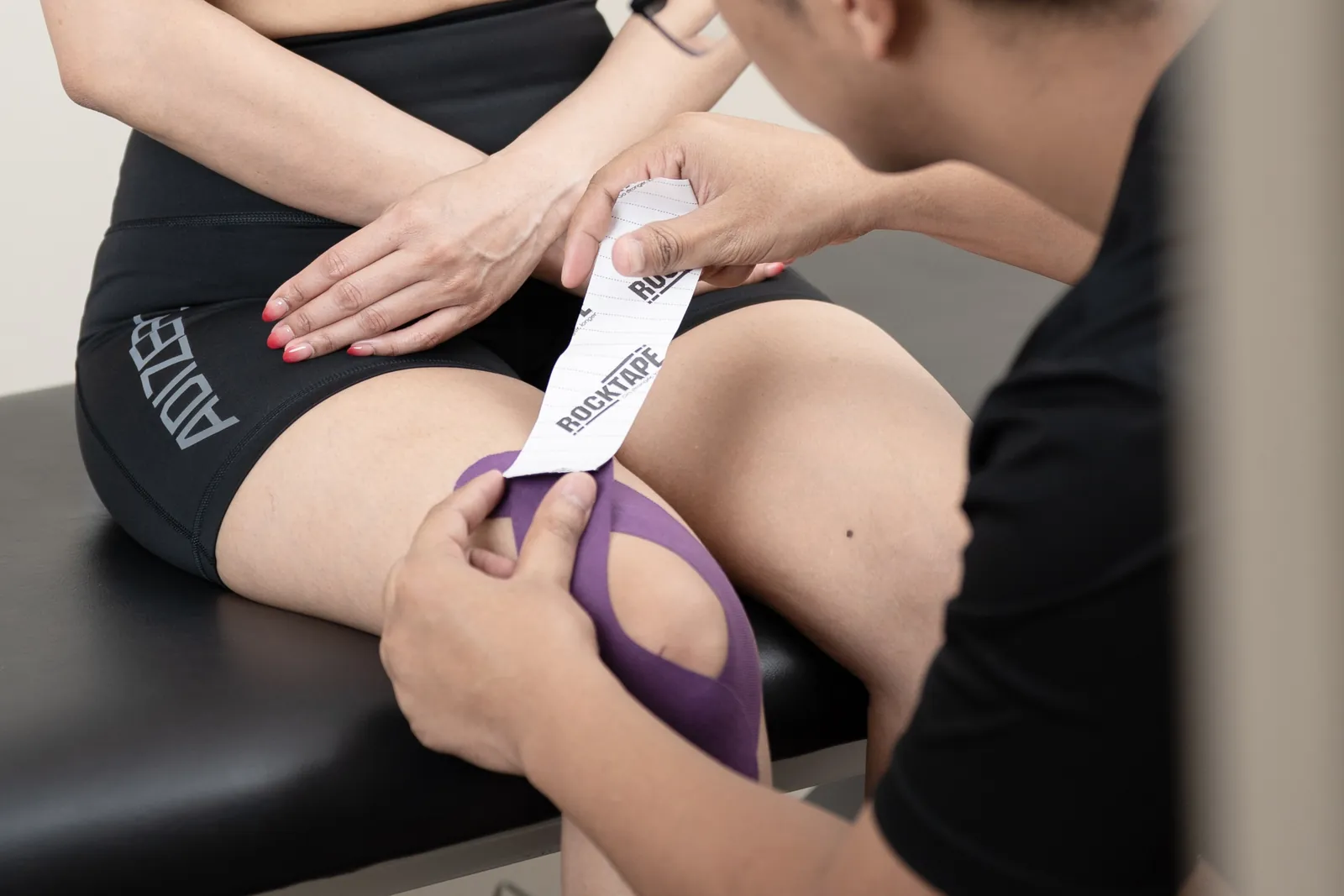
When the knee is sore, we use hands-on work to calm it down. That can include manual therapy, joint mobilisation, soft tissue work on the thigh and calf, and dry needling where it suits you. We may also adjust your training or daily load for a short while so the knee isn’t aggravated every day. This part helps with pain and movement in the short term. It doesn’t build the strength the knee needs to cope on its own, so it’s never the whole plan.
The strength phase: hips and quads
This is where most of the lasting change happens. Your physiotherapist takes you up to the gym floor, often in the same session, and coaches your exercises in person. For most knees the focus is:
- Quads: the main muscle group that controls the knee. We start with positions the knee tolerates, such as partial squats, step-ups or wall sits, then add range and load week by week.
- Hips: the glutes and hip rotators control whether your knee drifts inwards when you land, step or squat. Single-leg work and hip strength exercises are a big part of most knee plans.
- Calves and ankles: they absorb load before it reaches the knee, especially in runners.
- Control and landing: for people returning to sport, we add hopping, landing and change-of-direction drills once the basics are strong.
Some discomfort during exercise can be acceptable, and your physiotherapist will show you how to judge it so you’re not guessing at home. The gym is Aspire Coaching, in the same building, so there’s no gap between the treatment room and the strength coaching floor. You can read more about why this matters in our post on strength training during rehabilitation.
How many sessions most people need
It depends on what’s going on, how long you’ve had it, and what you want to get back to. As a rough guide:
- Recent, mild pain at the front of the knee often improves noticeably within a few weeks once load is adjusted and strength work starts.
- Pain that has been around for months, tendon problems and knees with osteoarthritis usually take longer, because strength and tissue tolerance build over months.
- A return to running or field sport after a ligament or meniscus injury is a longer, staged process.
Sessions are usually closer together at the start, then spread out as you take over more of the work yourself. We’ll give you a realistic estimate at your first visit and review it as you progress. We won’t promise a set number of sessions, because knees don’t work that way.
Cost and insurance
Your first consultation is free. If you have health insurance, you can claim with your insurer, and we’ll supply the documents your provider asks for. It’s worth checking your policy’s physiotherapy cover before you start. See our insurance claims page for how claiming works.
Your physiotherapists
Your knee is treated by one of our licensed physiotherapists: Boom Namsak, who is both a physiotherapist and a strength coach, Gino Udomthanakij, or Som Benjaprasertsri. They all work in English and Thai, and they all coach the gym-floor part of your rehab themselves.
Common questions
Do I need a scan before I see a physiotherapist for knee pain?
Usually not. Most knee pain can be assessed and treated without a scan. If your assessment suggests a scan or a specialist opinion would change the plan, we’ll tell you and refer you.
Can physiotherapy help a meniscus tear?
Many meniscus tears settle with physiotherapy and strength work, especially in people over about 40 where the tear is often part of normal wear. A knee that locks and won’t straighten needs a medical review first.
Can physiotherapy help knee pain from osteoarthritis?
Yes, in most cases. Exercise is one of the main recommended treatments for knee osteoarthritis. We can’t reverse the joint changes, but stronger muscles around the knee usually mean less pain and more you can do.
Should I stop running if I have runner’s knee?
Not always. Many runners keep some running while we reduce the load that aggravates the knee and build strength. Your physiotherapist will set a running level the knee tolerates and build it back up from there.
Why do you work on my hips when my knee hurts?
Your hip muscles control where your knee goes when you step, land and squat. If they’re weak, the knee often drifts inwards and takes extra strain. Strengthening the hips is one of the most useful things you can do for many types of knee pain.
How much does knee physiotherapy cost?
The first consultation is free. You can claim with your insurer, and we supply the documents your provider asks for.
Free first consultation
Book a knee assessment
Aspire Physio Bangkok is at Jasmine Building, 2nd Floor, Sukhumvit Road, Soi 23, a short walk from Asok BTS and Sukhumvit MRT. We’re open Monday to Friday 7am to 8pm, and Saturday and Sunday 8am to 4pm. Bookings are required in advance. Book your free first consultation through our contact page or call 082-281-8009.